
Music Bio
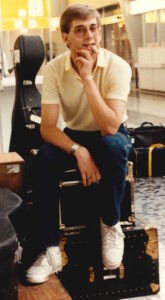
Stephen P. Brown started writing music at sixteen and hasn’t stopped. Ninety-three compositions later — string quartets, percussion ensembles, wind bands, solo piano, orchestral works — the catalogue spans nearly four decades and two continents.
A significant part of that catalogue belongs to an ongoing project: setting each of the 150 Psalms to original music. Fifty-seven are complete, ranging from solo instrumental miniatures to works for full choir and orchestra. Among them is his flagship work, Celebration — a setting of Psalm 100 for orchestra, and the piece most often used to introduce his music to new audiences.
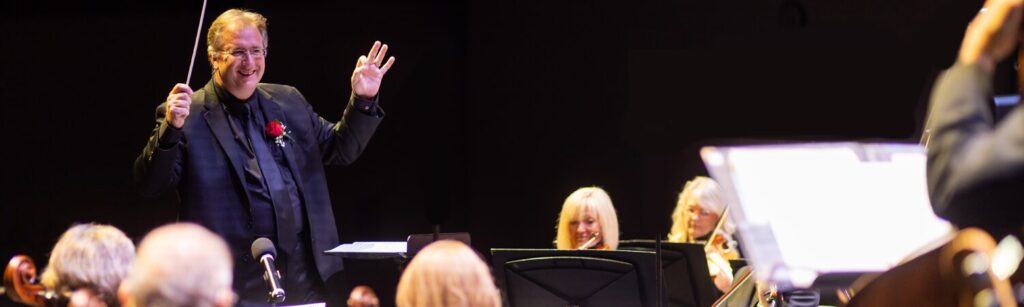
Brown’s conducting career grew alongside his composing. Trained at Trinity College of Music, London — where he completed an advanced Graduate Diploma credential developed in collaboration with the college’s principal, trumpeter Philip Jones, and conductors Arthur Davison and Bernard Keefe — he went on to serve as Student Observing Conductor with the Hallé Orchestra and pursued equivalent work independently with the BBC Philharmonic, which later formalized the role. He conducted professional and amateur orchestras, choirs, concert bands, chamber ensembles, and stage musicals throughout the UK and the US, founded the Medway Chamber Orchestra and the Concert University coaching program, and spent six years as General Director of the Dunedin Music Society, where he led a network of ensembles through nearly a thousand events.
His work has been recognized with two Global Music Awards for composition, an Award of Excellence and an Award of Merit from the same organization, a #2 US ranking on Reverbnation’s classical charts, and Creative Loafing’s “Best Classical Musician” in Tampa Bay’s Best of the Bay. Earlier in his training, he received the Alan J. Kirby Choral Conducting Prize and the Ricordi Conducting Prize.
None of this was ever separate from the rest of his life’s work. The same conviction that shapes his leadership writing — that excellence and joy are not competing values but the same pursuit, rightly ordered — is what a string quartet or a wind band arrangement was built to carry in the first place. For Brown, a well-made piece of music is a form of stewardship: something built with care, offered honestly, and meant to be used well by the people who perform it.
None of this is meant to be read about. A six-piece introduction — Celebration among them — is on Spotify, and the fuller catalogue is collected on YouTube. Both are the fastest way to know whether a piece belongs in your program.