
Attention Management: The Skill No One Taught You
Why protecting your attention matters more than managing your calendar
“I performed one of the most profound works in Western music two dozen times—
and barely experienced it once.”
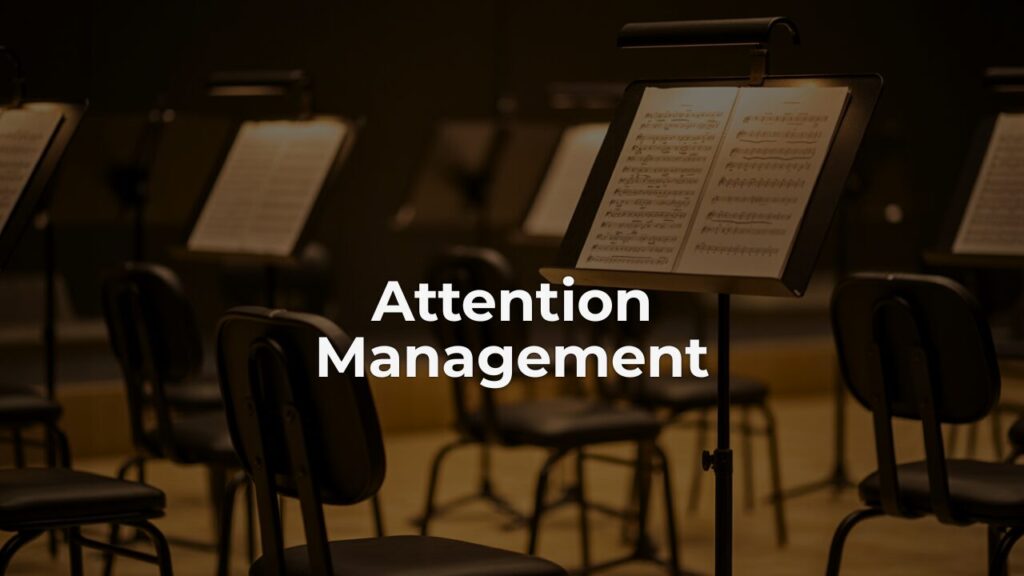
One winter, my calendar was a case study of relentless motion. Between November and April, I performed Handel’s Messiah twenty-two times—sometimes on timpani, sometimes singing in the choir, sometimes conducting. Add teaching commitments, pantomime shows, Christmas concerts, and the usual orchestral programs, and my schedule looked like a masterclass in efficiency.
But efficiency isn’t the same as presence.
I showed up on time. I wore the right attire. I hit every cue. But I couldn’t tell you which of Messiah’s 53 movements were cut to accommodate a single intermission, or that the soprano soloist was exhausted from flying halfway around the world that morning. I didn’t absorb the text I was helping to deliver. Messiah was composed for Easter, not Christmas—a fact I knew intellectually but never felt during that blur of a season.
I had managed my time flawlessly. What I hadn’t managed was my attention.
Time was abundant. Attention was the scarce resource. And I’d spent it all on logistics, leaving none for meaning, connection, or even simple enjoyment. I performed one of the most profound works in Western music two dozen times—and barely experienced it once.
Busyness without awareness is noise in motion. If you want your days to feel purposeful instead of frantic, you must learn to protect what’s truly scarce: not your hours, but your attention. Three shifts can restore presence to even the fullest schedule.
From autopilot to awareness
Autopilot feels efficient. It lets you move through your day without thinking too hard. But autopilot also turns life into a checklist—tasks completed, boxes ticked, nothing truly experienced.
Psychologist Ellen Langer calls this “mindlessness,” a state where we operate on habit rather than intention.¹ We respond to emails without reading them carefully. We sit in meetings without tracking the conversation. We drive home and can’t remember the route.
Awareness doesn’t require you to slow down. It requires you to notice. Where is your attention right now? On the person in front of you—or the notification on your phone? On the work itself—or the worry about finishing it?
The shift begins with one question: What am I actually noticing right now? Ask it once today. Let the answer surprise you.
From multitasking to single focus
We’ve been told multitasking is a skill. Research tells a different story. A landmark Stanford study found that heavy multitaskers perform worse at filtering irrelevant information, switching between tasks, and—ironically—multitasking itself.² What feels like productivity is often fragmented attention producing fragmented work.
Neuroscientist Daniel Levitin puts it bluntly: “Multitasking creates a dopamine-addiction feedback loop, effectively rewarding the brain for losing focus.”³ We feel busy. We feel productive. But we’re training ourselves to scatter rather than concentrate.
Single focus doesn’t mean doing less. It means doing one thing at a time with your whole mind.
When you’re writing, write. When you’re listening, listen. When you’re leading a meeting, lead it—don’t draft emails in your head while nodding along. The people around you can sense when you’re only half present. So can you.
Start with five minutes. Give one task your full attention. Notice how different it feels—not just in the quality of work, but in the quality of experience.
From performance to participation
Performance is about outcome. Participation is about presence.
During that Messiah season, I performed brilliantly by every external measure. I hit every cue, managed every transition, delivered every note. But I wasn’t participating in the music—I was executing it. I treated the work as something to accomplish rather than something to inhabit.
This distinction matters because participation changes the quality of your experience. When you participate, you’re not merely completing tasks—you’re engaging with meaning. You notice the texture of the work, the people involved, the moments that matter.
Participation asks a simple question: Am I here, or am I just getting through this?
You don’t have to participate fully in everything. Some tasks are purely functional, and that’s fine. But the moments that matter—the conversations, the decisions, the creative work, the people you serve—deserve more than performance. They deserve your presence.
Attention is the currency of a meaningful life. You can spend it on logistics and lose the experience. Or you can spend it on presence and gain everything else.
The shifts aren’t complicated. They’re gentle redirections: from autopilot to awareness, from multitasking to single focus, from performance to participation. Each one invites you back to what’s real, what’s here, what matters.
You don’t need more time. You need more attention on the time you already have.
One Takeaway Action: This week, choose one recurring activity—a meeting, a conversation, a creative task—and practice full presence for just five minutes. Notice what shifts when you stop performing and start participating.
What would it mean for your work if you protected your attention as fiercely as you protect your calendar?
If this reflection helped you, consider subscribing to The Maestro’s Dispatch: join us here and receive weekly reflections on leading with clarity, wisdom, and joyful excellence.
Endnotes
¹ Ellen J. Langer, Mindfulness (Reading, MA: Addison-Wesley, 1989), 12–16.
² Eyal Ophir, Clifford Nass, and Anthony D. Wagner, “Cognitive Control in Media Multitaskers,” Proceedings of the National Academy of Sciences 106, no. 37 (2009): 15583–15587.
³ Daniel J. Levitin, The Organized Mind: Thinking Straight in the Age of Information Overload (New York: Dutton, 2014), 96–97.

