

The Wisdom of Not Yet
On holding decisions long enough to hear what they’re actually asking.
Speed feels like leadership. And sometimes it is. But there’s a category of decision that rewards neither urgency nor delay — it rewards the quiet discipline of waiting until clarity arrives on its own terms.
If this is your first time here — welcome. The Maestro’s Dispatch is a weekly note on clarity, leadership, and joyful excellence. If it resonates, you are warmly invited to subscribe here.
The campaign was fully alive. The goal was bold. Monies raised. Plans drawn. Community consulted. Every signal said: go.
We chose to stop.
I was helping a large church launch a visionary capital campaign — new facilities, new campuses, church plants reaching across the world. One building project sat fully engineered, fully funded, ready to break ground. But something in the room felt wrong. Not fearful. Just… unresolved. Is this the right moment? Can we sustain what we build?
We delayed. Two years later, we began. The community had grown significantly. We deferred unnecessary elements without losing the vision — spending only what the moment required. The facility was built on firmer ground — literally and organizationally.
That pause wasn’t hesitation. It was discernment. Waiting didn’t feel triumphant in the moment. But it gave us the energy, focus, and sustainability that forcing the timeline would have squandered.
The gap between a premature decision and a well-timed one is rarely a matter of information — it’s a matter of grounding. This week you’ll explore three rhythms that create space between the pressure to decide and the moment you actually do, so that when you act, you act from clarity rather than noise.
Rhythms that surface what’s unresolved
You’ve felt it. The decision is technically ready. The information is sufficient. But something sits just beneath the surface that you haven’t yet named.
Most of us respond to that sensation by pushing harder — gathering more data, scheduling another meeting, or simply deciding to relieve the discomfort. What we rarely do is sit with the question long enough to hear what it’s actually asking.
The most arresting argument for the necessity of unresolved tension may be the one found between Good Friday and Easter Sunday. Holy Week — the days between the cross and the empty tomb — holds a silence that most readers of that story have spent little time inside. The disciples didn’t know Saturday was temporary. They only knew that everything had gone silent. And yet something was being completed in that silence that could not have been accomplished through action.¹
Your decision doesn’t need more pressure. It may need the kind of quiet that lets what’s unresolved rise to the surface. Before you move, ask: What is this decision actually asking of me that I haven’t yet answered?
Rhythms that hold the tension
Holding a decision in suspension feels, to most leaders, like weakness. In my experience, we’ve confused speed with wisdom. The colleague who decides quickly is admired. The one who pauses is questioned. So we train ourselves to resolve discomfort through action — even when action is precisely what the moment doesn’t need.
Organizational psychologist Sophie Leroy has studied what happens when we force closure before we’re ready. Her research on attention residue reveals that when we abandon important questions unfinished and rush to the next thing, part of our mental attention stays anchored to what we didn’t fully process — quietly undermining everything that follows.² The mind knows when something is unresolved, even when we’ve told ourselves otherwise.
Holding tension isn’t paralysis. It’s presence. It means staying with the open question — not collapsing it — while continuing to lead the things that are already clear. The practical form is simpler than it sounds: identify one decision you’ve been forcing, and give it a deliberate return date. Not indefinitely open. Not urgently closed. A day to come back with fresh eyes.
Rhythms that release with confidence
There’s a moment — and you’ll recognize it when it arrives — when the decision that was murky becomes clear. Not because anything dramatic changed. But because you gave it the time it needed.
Michael Hyatt describes this kind of intentional patience in Free to Focus as part of what distinguishes leaders who sustain excellence from those who burn through it.³ The goal isn’t indecision. It’s decision in its season. And when that season comes, you act — not with certainty that every outcome is guaranteed, but with confidence that you’ve been faithful to the clarity available to you.
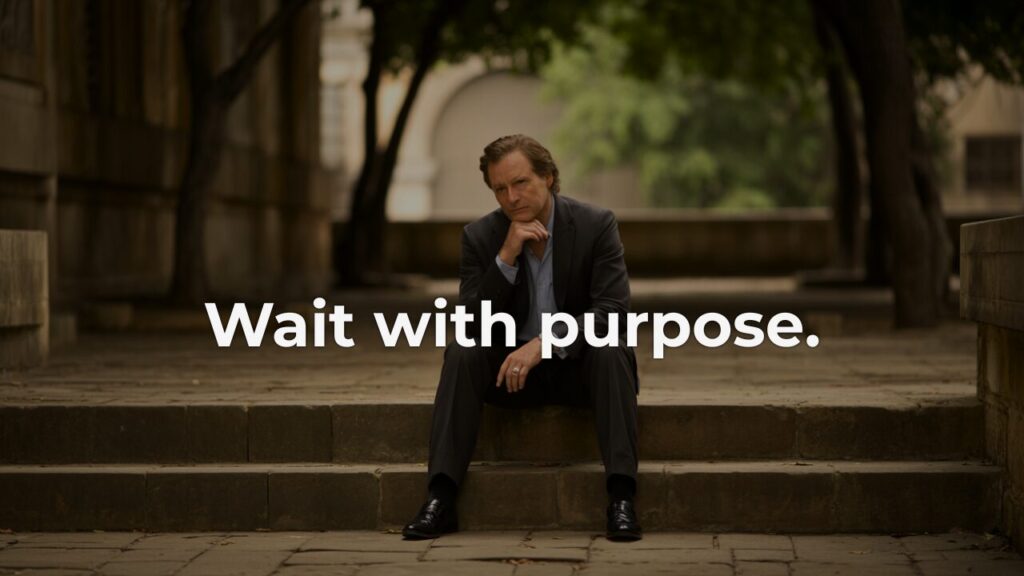
The facility we eventually built served its community well. Not because we had more information the day we broke ground than the day we paused. But because the community, the timing, and our own readiness had grown into the vision. We hadn’t waited passively. We had waited purposefully — and that made all the difference.
Cal Newport observes that we have allowed noise to colonize the core of our daily lives, crowding out the reflective attention that good judgment requires.⁴ The antidote isn’t a quieter world. It’s a more deliberate practice of creating quiet within the world we actually inhabit.
We assume that waiting is what happens when nothing is happening. Holy Week reorders that assumption entirely. The pause between Friday and Sunday wasn’t absence — it was the hinge on which everything turned. Your unresolved decision may be carrying more than you know. Neither is your waiting empty.
The rhythms of surfacing, holding, and releasing aren’t techniques for the indecisive. They are the practice of leaders who have learned that clarity isn’t found by forcing decisions — it’s earned by honoring the time they need to form.
Delay one decision this week. Return to it with clarity. See what was waiting for you.
What is one decision you’ve been forcing that deserves a deliberate pause before you act?
If this kind of grounded, unhurried leadership resonates with you, The Maestro’s Dispatch arrives every Tuesday — practical wisdom for leaders who want to lead well without losing themselves in the process.
Endnotes
¹ The theological weight of Holy Saturday — the interval between crucifixion and resurrection — is addressed in Reformed theological reflection on the completion of redemptive work within the apparent silence. See Thomas F. Torrance, Atonement: The Person and Work of Christ, ed. Robert T. Walker (Downers Grove: IVP Academic, 2009), 238–242.
² Sophie Leroy, “Why Is It So Hard to Do My Work? The Challenge of Attention Residue When Switching Between Work Tasks,” Organizational Behavior and Human Decision Processes 109, no. 2 (2009): 168–181.
³ Michael Hyatt, Free to Focus: A Total Productivity System to Achieve More by Doing Less (Grand Rapids: Baker Books, 2019), 112–117.
⁴ Cal Newport, Digital Minimalism: Choosing a Focused Life in a Noisy World (New York: Portfolio/Penguin, 2019), 6.

