
The Room Already Knows
Learn why the room responds to you long before your first sentence arrives.
Some of the most important shifts in a team’s energy happen without a single explanation. They happen because someone in the room decided, quietly, to carry something steadier.

If this is your first time here, welcome. The Maestro’s Dispatch is a weekly note on clarity, leadership, and joyful excellence. If it resonates, you are warmly invited to subscribe here.
I was fifteen, playing percussion in the New Jersey Youth Symphony. We were six or seven weeks into a long rehearsal cycle, deep in the unglamorous middle sections of a piece: the connective tissue between the exciting moments. The room was too small, the air was stifling, and everyone was spent.
Most players disengaged when they weren’t playing: homework out, books open, half asleep. I didn’t. I already knew I wanted to conduct, so I followed every rehearsal with a score, watching how energy moved through the room. And I could feel it: something heavy. Even our conductor, a good musician who was genuinely trying, carried a visible weariness. No one named it. We just felt it.
Tom, sitting next to me, felt it too. We exchanged a look, no words, no plan, just a shared sense: this room needs life.
When our entrance came, we stood without hesitation and played, not louder, just alive.
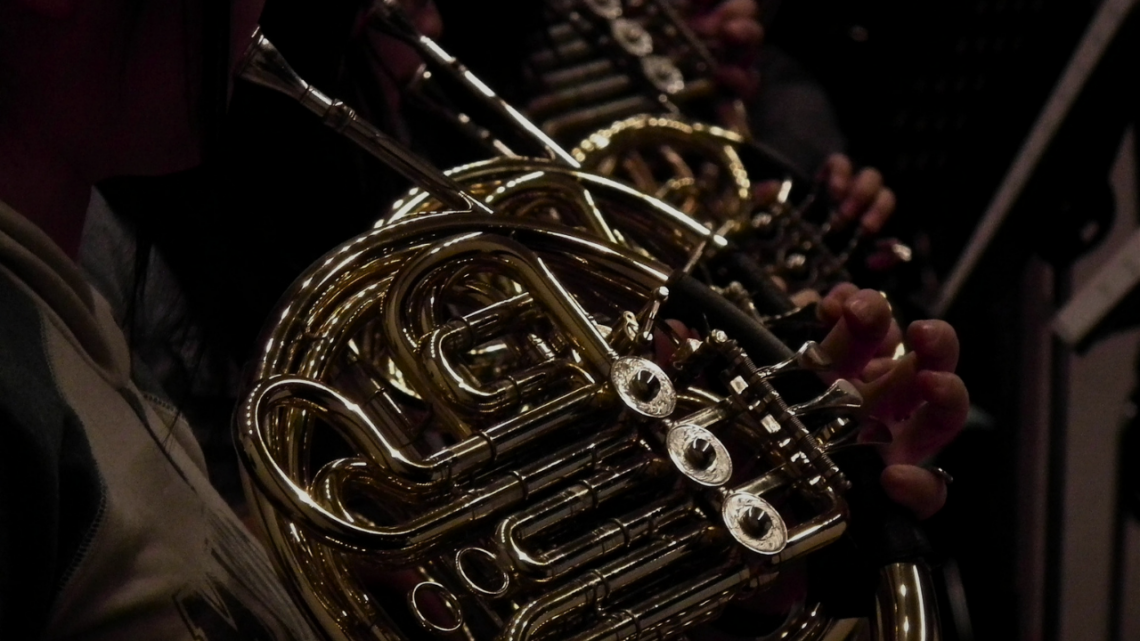
Within a dozen bars, the French horns in front of us sat up. Books closed. The sound brightened. The shift spread outward through brass, winds, and strings until the whole room had changed. No one had announced anything. No one needed to.
———-
We tend to assume our impact on a room begins with our first sentence, and that influence is something built through argument, persuasion, or authority. But long before we speak, a room is already picking up something quieter and faster: the presence we bring to it.
Frequencies Arrive First
We spend most of our preparation on the wrong thing when we assume influence starts with our first sentence. We rehearse what we’ll say. We rarely rehearse what we’re already transmitting before we say it.
Researchers who study how quickly people form accurate impressions of each other found something almost uncomfortable: observers can predict outcomes, how a doctor’s patients will rate them, how a teacher’s students will evaluate their semester, from clips of behavior lasting only a few seconds.¹ Not words. Behavior. Tone, posture, pace. The room reads us the way I read that rehearsal hall at fifteen: quickly, and mostly without meaning to.
This isn’t a trick to master. It’s simply true, the way tuning is true before a note is played. Once you know it, the real work of opening well moves from your sentence to your body, to whatever you’re carrying in the sixty seconds before you speak.
Frequencies Change Rooms Quietly
We also assume that changing a room requires explaining what should change: a pep talk, a directive, a case made. Tom and I never said a word. We simply played differently, and the room around us reorganized itself in response.
There’s a name for what happened in that rehearsal hall. Psychologists call it emotional contagion, the well-documented tendency for moods to transfer between people through tone, facial expression, and posture, often faster than either party consciously registers it.² Some of the machinery behind this appears to be built into how we’re wired: neurons that fire both when we act and when we simply observe someone else acting, quietly synchronizing us with whoever is in the room.³
The practical shift is simpler than explaining your intentions more clearly, and honestly harder: change what you’re transmitting before you try to change what anyone hears. Steady your own pace, and the room has less choppiness to catch.
Frequencies Steady With Slowing
None of this works if you’re moving too fast to notice your own frequency in the first place. That’s the piece most of us skip.
The philosopher Simone Weil once wrote that attention is “the rarest and purest form of generosity.”⁴ I’ve come to believe that’s true of leadership as much as anything else. Before I can offer a room something steady, I have to notice what I’m already carrying into it: the tension in my shoulders from the meeting before, the hurry in my breath, the unresolved thing I haven’t set down.
This is where the discipline actually lives: one slow breath before the door opens. Not a technique for controlling the room. A moment of honest noticing, so what you bring in is chosen rather than accidental.
Musicians have a word for this kind of shared timing: entrainment, the way independent rhythms lock into a common pulse.⁵ A room entrains to whoever is steadiest in it. That’s not pressure. That’s an invitation to bring something worth entraining to.
———-
You don’t have to perform your way into a room, and you don’t have to announce your intentions before anyone takes you seriously. What you carry into it, your pace, your attention, your quiet, is already doing more work than your first sentence ever will. The invitation is simply to notice it, and let it be something worth receiving.
Presence is a frequency, and frequencies are steadied one unhurried breath at a time.
What frequency have you been bringing into the rooms you enter this week, and have you taken long enough to notice it before you walk in?
Enjoyed this? The Maestro’s Dispatch arrives every Tuesday. Subscribe here.
———-
Endnotes
¹ Nalini Ambady and Robert Rosenthal, “Thin Slices of Expressive Behavior as Predictors of Interpersonal Consequences: A Meta-Analysis,” Psychological Bulletin 111, no. 2 (1992): 256-274.
² Elaine Hatfield, John T. Cacioppo, and Richard L. Rapson, “Emotional Contagion,” Current Directions in Psychological Science 2, no. 3 (1993): 96-100.
³ Giacomo Rizzolatti and Laila Craighero, “The Mirror-Neuron System,” Annual Review of Neuroscience 27 (2004): 169-192.
⁴ Simone Weil, “New York Notebook” (1940), in First and Last Notebooks, trans. Richard Rees (London: Oxford University Press, 1970).
⁵ Martin Clayton, Rebecca Sager, and Udo Will, “In Time with the Music: The Concept of Entrainment and Its Significance for Ethnomusicology,” European Meetings in Ethnomusicology 11 (2005): 3-142.
