

The Quiet Kind of Courage
A few small shifts that make composure possible before the pressure ever arrives.
Some leaders reach for the loudest response when pressure hits. Here’s what happens when you reach for something quieter instead.
If this is your first time here — welcome. The Maestro’s Dispatch is a weekly note on clarity, leadership, and joyful excellence. If it resonates, you are warmly invited to subscribe here.
Churches are always chasing the next attraction. Whatever trend promises to pull people in — a bigger event, a flashier format, a one-night spectacle — the pressure is to say yes. I’ve learned to say no more often than I’d like to admit.
What I’m after isn’t loud. It’s quiet, steady, and consistent — small if it has to be, but never skipped. I’ve pushed back more than once when a one-off “fun idea” threatened to bump a regularly scheduled gathering, like our men’s breakfast. Same time, same place, every month. No exceptions.
One year, that meant holding the breakfast on July 4th, a morning most people assumed we’d quietly cancel. We didn’t. It turned out to be one of our best-attended breakfasts all year.
That’s what quiet courage looks like to me. Not the loud, trendy, trying-to-stay-relevant approach. The reliable one. The one who shows up when showing up isn’t exciting, because steadiness is its own kind of strength, and its own kind of witness.
———
When the moment gets tense, you can reach for something more reliable than raw willpower. A few small shifts, practiced long before the pressure hits, are what make calm strength possible instead of just hoped-for.
Decide What Matters Early
Most of us wait until the tense moment to figure out what we actually value. The deadline arrives, the criticism drops, the legal documents land, and only then do we start asking what matters most. By that point, adrenaline is doing the deciding, not us.
There’s an old story about a government official named Daniel who kept a habit of praying three times a day, every day, long before any threat existed. When a new law made that habit illegal, he didn’t call an emergency meeting to decide what he should prioritize. He went to his room and knelt down, “as he had done previously.”¹ The priority had already been decided. The crisis just revealed it.
Researchers who study habit formation call this a keystone shift: one small, repeated practice that quietly reorganizes everything else around it.² You don’t have to overhaul your whole life to build this kind of readiness. You just have to decide, on an ordinary Tuesday, what you’ll return to when Wednesday gets hard.
Choose Steady Over Loud
Tense moments have a way of rewarding whoever makes the biggest scene. The louder response looks like strength. The quieter one can look like you’re not taking things seriously enough.
But some of the most enduring leaders operate the opposite way, plainly, almost invisibly, letting the results speak instead of the performance.³ At the men’s breakfast, the shift wasn’t dramatic. Nobody made a speech about resisting cultural pressure. We just kept meeting. Same time, same place, no announcement required.
This is the shift most of us rarely get permission to make: the option to be the steady one instead of the memorable one. Loud isn’t always strong. Quiet isn’t always weak.
Let Showing Up Count
Here’s the part that’s easy to miss: repeated ordinary faithfulness rarely feels like courage while you’re living it. It feels like nothing much, the same food, the same room, mostly the same crowd (yes, at breakfast!), month after month. You start to wonder if it’s actually doing anything.
It is. Researchers studying trust inside organizations have found that consistency, more than charisma, predicts whether people extend confidence to a leader over time.⁴ Trust isn’t won in a single dramatic gesture. It compounds quietly, through everything a person does when nobody’s counting.⁵ That July 4th breakfast wasn’t remarkable because of what we said. It was remarkable because we were there, again, when everyone assumed we wouldn’t be.
This is the shift that turns a habit into a witness: showing up doesn’t just demonstrate courage. Eventually, it becomes courage, the kind nobody notices until they need it.
———
None of this needs an audience. Your has shift already happened, back in some ordinary week, long before the pressure showed up to test it.
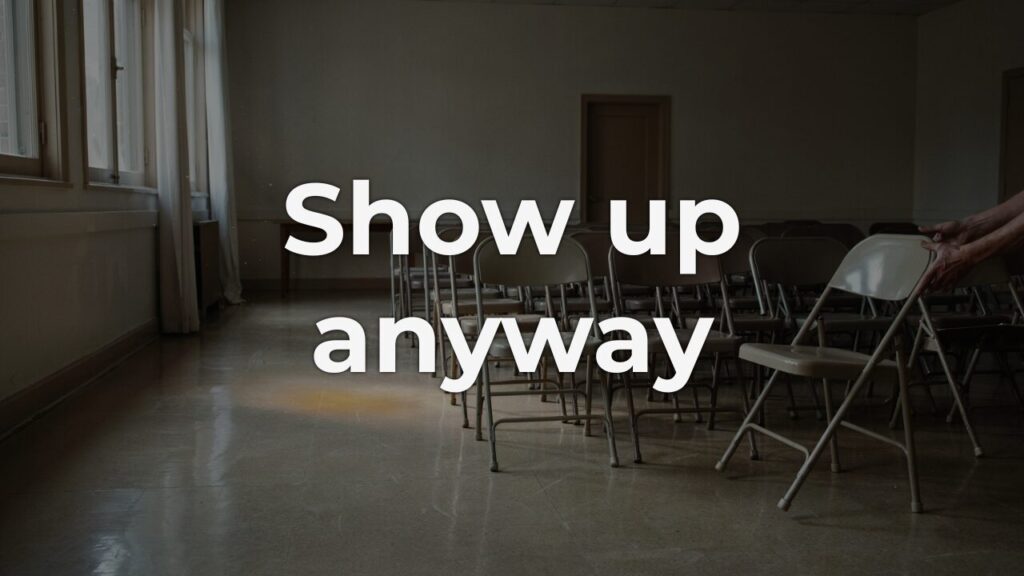
Somewhere there’s a room with some chairs, a pot of coffee, and a door that opens at the same time it always does. That’s what calm strength actually looks like from the outside. Nothing to applaud. Just someone who showed up again.
What’s one ordinary commitment you could decide, right now, to keep, long before the next tense moment asks you to?
If this steadied something in you, forward it to someone who could use a little calm strength this week.
Endnotes
¹ Daniel 6:10 (ESV).
² Charles Duhigg, The Power of Habit: Why We Do What We Do in Life and Business (New York: Random House, 2012), 109.
³ Jim Collins, Good to Great: Why Some Companies Make the Leap…and Others Don’t (New York: HarperBusiness, 2001), chap. 2.
⁴ Paul J. Zak, “The Neuroscience of Trust,” Harvard Business Review 95, no. 1 (2017): 84–90.
⁵ Stephen M. R. Covey and Rebecca R. Merrill, The Speed of Trust: The One Thing That Changes Everything (New York: Free Press, 2006).

