How to Navigate a Tense Room With Confidence
What a rehearsal, a furious violinist, and one calm tenor taught me about leading under pressure
What if the strongest thing you can do in a tense moment isn’t to fix it, but to call upon your dignity?

If this is your first time here — welcome. The Maestro’s Dispatch is a weekly note on clarity, leadership, and joyful excellence. If it resonates, you are warmly invited to subscribe here.
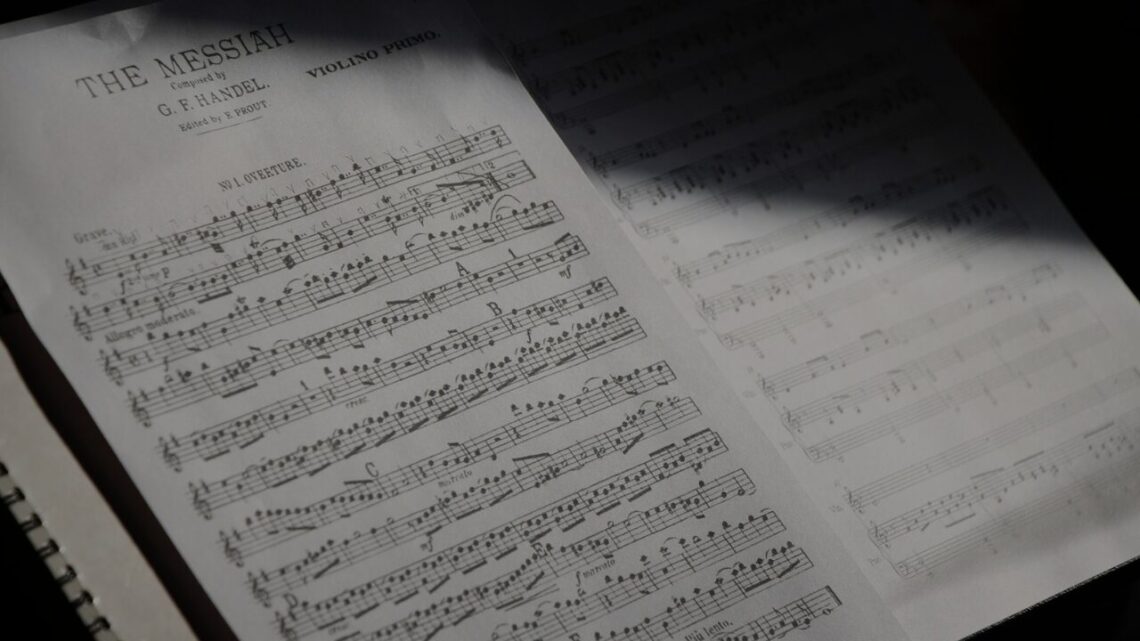
Six days after the scheduled conductor fell ill, I stood in front of an orchestra, choir, and soloists I barely knew, preparing for a performance of Handel’s Messiah that same night. We had three hours of music and less than two hours to rehearse it. Partway through one of the most beautiful movements, the lead violinist stopped playing. She stood in front of everyone, and told me the tempo was ruining the music, that I was destroying something sacred. The room went silent. The young soprano soloist looked terrified, unsure what was happening or what came next.
I froze. I had the authority of the podium, but at that moment, I had no idea how to use it. That instrumentalist’s outburst was a new experience for me.
A moment later, the tenor soloist spoke, not to the violinist, not even looking around the room, but facing the empty audience pews ahead of him. Calmly, firmly, he reiterated that I was the conductor, that I was doing everyone a favor by stepping in on short notice, and that we needed to keep moving. No raised voice. No drama. Just steady, settled conviction.
The tempo didn’t change. But the room did. His presence, not his volume, was what brought the tension down, and it’s one of those lesson-learned moments that’s stuck with me ever since.
———
I used to think a tense room needed a strong hand or booming voice to settle it. What that rehearsal taught me is that a room reads your steadiness long before it reads your solutions. That changes what leadership should look like under pressure.
Postures of Attention
Before you can settle a room, you have to actually see what’s happening in it. That sounds obvious, but most of us skip straight to fixing. We hear a raised voice or feel a shift in the air and our minds jump immediately to strategy: what do I say, what do I do, how do I make this stop. Attention gets bypassed entirely.
Researchers who study conductors found something worth sitting with: when they showed the same orchestral recording to listeners, but paired it with video of either an expressive or a flat conducting style, people rated the performance itself as better or worse depending on what they saw, even though the sound never changed.¹ The visible presence shaped the perceived quality of everything underneath it. A tense room works the same way. People are reading you before they’ve processed what’s actually being said.
That tenor didn’t rush to interpret the violinist’s tantrum. He let it land, took it in, and only then responded, to the room’s need, not just to her words. Attention isn’t passive. It’s the discipline of seeing clearly before you act, so what you do next actually fits what’s really happening.
Postures of Stillness
Once you’ve seen the room accurately, the temptation is to fix it immediately. Stillness asks you to wait one more beat than feels comfortable.
There’s a reason for this beyond good manners. Our nervous systems are constantly, unconsciously scanning the people around us for cues about whether we’re safe, a process neuroscientist Stephen Porges calls neuroception.² We don’t wait for someone to explain that everything is fine. We read it off their breathing, their posture, the steadiness of their voice. A leader who is visibly regulated becomes, in a very real physiological sense, a signal the room can borrow.
This is the part I still find hardest. Ben Horowitz, who spent years running a company through repeated near-collapses, called managing his own psychology the single hardest skill of the job, harder than any strategic decision he ever made.³ I believe him. Staying still while a room wants you to react is its own kind of labor, invisible to everyone watching. But it’s the labor that actually holds.
Postures of Confidence
Attention lets you see. Stillness lets you hold. Confidence is what lets you trust that holding is enough, that you don’t have to win the argument in the moment to lead well through it.
I used to think confidence meant having the right comeback ready. What that rehearsal taught me is closer to what one family therapist turned leadership writer called a “non-anxious presence,” the capacity to stay steady inside a room’s anxiety without absorbing it or needing to resolve it on the spot.⁴ You don’t have to win the argument in the moment to lead well through it. The room can hold without you forcing it.
Even the old Stoics understood something like this: that we can’t control what happens to us, only how we carry ourselves while it’s happening.⁵ The tenor that day didn’t control the violinist, or the rehearsal. He controlled his own composure, and that was enough to change the temperature of the room.
———
Attention, stillness, confidence: three postures, and none of them require you to be the loudest voice. They ask something quieter and, honestly, harder: that you trust your steadiness to do work your words can’t.
I think about that tenor more than I think about almost anyone else from those early conducting years. He never raised his voice, and he never needed to. He simply rested in what was true and let the room catch up to him. It’s almost inconsequential that the performance had such an emotional impact on us all, that the soprano now insists on my tempo for that movement, wherever, whenever, and with whomever she sings it.
The next time you walk into a room that feels tense before anyone says a word, you don’t have to fix it right away. Notice it. Hold your footing. Trust that your presence is already doing more than you think.
What is your presence already saying to the rooms you walk into, before you’ve said a word?
If this one landed, forward it to a friend who’s learning to lead with a little more steadiness this week.
Endnotes:
¹ Steven J. Morrison, Harry E. Price, Eric M. Smedley, and Cory D. Meals, “Conductor Gestures Influence Evaluations of Ensemble Performance,” Frontiers in Psychology 5 (2014): article 806.
² Stephen W. Porges, “Polyvagal Theory: A Science of Safety,” Frontiers in Integrative Neuroscience 16 (2022): article 871227.
³ Ben Horowitz, The Hard Thing About Hard Things: Building a Business When There Are No Easy Answers (New York: HarperBusiness, 2014), 76–80.
⁴ Edwin H. Friedman, A Failure of Nerve: Leadership in the Age of the Quick Fix (New York: Seabury Press, 2007), 14.
⁵ Marcus Aurelius, Meditations, trans. Gregory Hays (New York: Modern Library, 2002), Book 5.

